
Running a Sex Offender Check in Jefferson County
The Pennsylvania State Police manages the Megan's Law Public Website under Pennsylvania's registration law. It is the official first source for Jefferson County sex offender records. Choose a name search when identity is known, county search for a broad local list, municipality or ZIP for a smaller area, or address search for a location-centered result. Search methods overlap, but they are not interchangeable.
The official registry landing screen displays the choices and conditions a reader should review before searching.
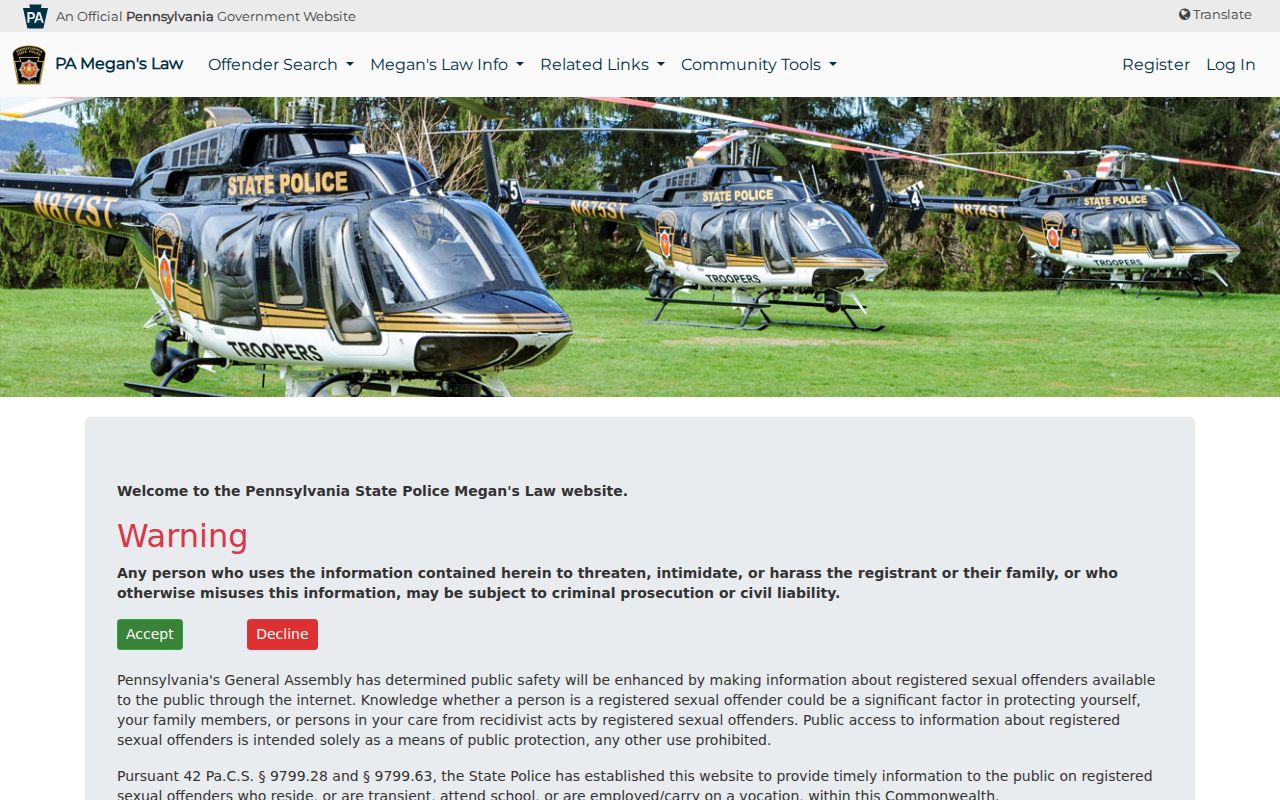
Starting with PSP keeps the check in the current state notification system rather than an unofficial copy.
Jefferson County Registry Results
A county filter is the broadest local view. It can include reported locations outside Punxsutawney, Brookville, and Reynoldsville, including townships and smaller boroughs. A municipality result can miss a nearby address just beyond the borough line, while ZIP boundaries do not always match municipal borders. Use more than one geographic method when the boundary itself matters.
The official Jefferson County results interface is the source for the county-filter image.
The interface should be used to read current public profiles, without copying a private individual's details elsewhere.
Start broad only when the location is the main fact. A name search is better when identity is already known, since geographic results can include people with similar names or addresses near a boundary. Compare the name, aliases, physical description, and reported location on the official profile. Do not use a result-list label alone as proof of identity. If an address has changed or appears outside the expected municipality, rerun the search by county and ZIP before drawing a conclusion.
Searching the Pennsylvania State Police Megan's Law Public Website
Begin by accepting the official notices, then choose the method that fits what is known. A Jefferson County sex offender search does not require calculating a tier or guessing from an offense name. Open the official profile and use the classification and compliance information PSP displays.
- Open the PSP Megan's Law Public Website and read the conditions of use.
- Select name, county, municipality, ZIP, or address search and enter the known facts.
- Review the result list carefully, including name variants and geography.
- Open the official profile and read its classification, offense, location, and compliance fields.
| Field Label | Type | Required | Notes |
|---|---|---|---|
| Search by Name | Tab and form | Conditional | Use first and last name with careful spelling |
| Search by County | Dropdown | Conditional | Select JEFFERSON |
| Search by Municipality | Geographic selector | Conditional | Choose the relevant borough or township |
| Search by ZIP Code | Text | Conditional | Returns the ZIP-based result set |
| Search by Address | Geocoder | Conditional | Street, city, ZIP, and live distance choices |
| Non-Compliant | Filter or link | No | Isolates that designated status where offered |
Jefferson County Verification Site
The PSP approved verification-site search identifies Jefferson County Jail at 578 Service Center Road in Brookville as a registration and verification location.
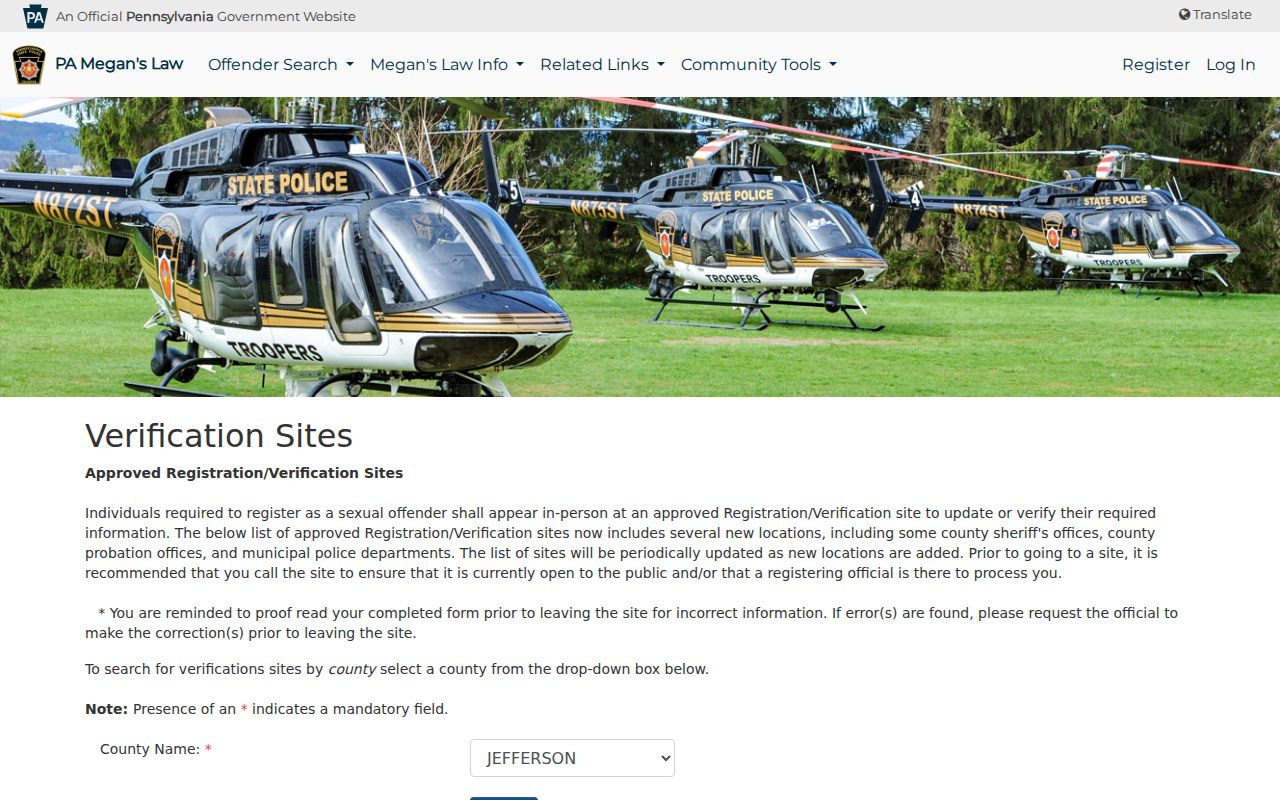
The listing does not establish walk-in hours or guarantee that every task is handled without scheduling.
A person with registration business should call 814-849-1933 before appearing. The public uses the PSP website for a Jefferson County sex offender check; the jail is not described as a separate public registry counter or local map. This split keeps the public search and the registrant's verification duties in their proper channels.
What a Registry Profile Shows
A PSP profile is a statutory public-notification record. It displays categories authorized by law, not every document from the underlying prosecution. A reader should not infer current risk, a full life history, or a complete court outcome from the profile alone. Where a Pennsylvania public docket exists, the court record is the separate source for case procedure.
| Name & Aliases | Reported identity and alternate names made public under the registry rules. |
|---|---|
| Photo & Description | Photo and authorized descriptors such as build, hair, eyes, and birth information. |
| Reported Locations | Residence, transient, work, vocation, and school data at the detail law permits. |
| Other Identifiers | Vehicles, scars, marks, and tattoos where required and reported. |
| Offense Information | Qualifying offense, statute or jurisdiction, conviction date, and lawful victim category. |
| Classification & Status | Tier or category, compliance status, and verification information shown by PSP. |
Jefferson County Radius Search Limits
An address or radius result answers a narrow geographic question. It is not a complete neighborhood safety assessment. Reported addresses can change, a search radius can stop at an arbitrary line, and the result does not include every kind of offense or concern. A county filter may find a record that a borough filter omits, while a municipality search may be more useful than a ZIP when local boundaries matter.
Registry presence also is not a prediction of present conduct. Use the official profile for the reported facts, compare search methods where appropriate, and rely on ordinary safety practices as well. Do not calculate a person's tier or duty from an offense label because conviction date, jurisdiction, later orders, and Pennsylvania case-law history can affect classification.
A Jefferson County county-filter result may include a reported township location just beyond a borough, while a Punxsutawney, Brookville, or Reynoldsville municipality filter is narrower. ZIP search follows postal geography. Address search follows the live form's geocoder and distance choices. None of those methods changes the legal classification shown on the profile. When two geographic searches seem inconsistent, open the profile from the official result, confirm the reported location category, and avoid guessing at a residence from a map marker alone.
Registration Requirements and Levels in Pennsylvania
Pennsylvania uses SORNA tiers and other categories shaped by statute and case law. The broad schedules below are useful headlines, not a tool for classifying a person. Readers should use the status PSP displays because the exact result can depend on the offense, conviction date, jurisdiction, court findings, and later orders.
| Level / Tier | Duration | Verification Frequency |
|---|---|---|
| Tier I | Generally 15 years | Annual |
| Tier II | Generally 25 years | Semiannual |
| Tier III | Generally lifetime | Quarterly |
| Sexually Violent Predator | Lifetime | Enhanced and community-notification rules |
Jefferson County Registry Law Context
The official Pennsylvania registration statute is 42 Pa.C.S. Chapter 97, Subchapter H.
The statute supplies the legal structure behind the classifications shown on PSP profiles.
Tier duration should not be read as a visual danger score. Sexually Violent Predator status involves distinct assessment, judicial, and community-notification provisions. Juvenile and nonpublic categories also require careful statutory treatment. If the profile and a remembered court outcome seem inconsistent, rely on the current official display and seek qualified legal help for classification questions rather than making an independent calculation.
The verification schedule explains why profiles can show different check-in patterns. Tier I generally verifies once each year, Tier II twice each year, and Tier III four times each year. Those are broad statutory headlines. A separate category or order can change the practical duty. Jefferson County Jail appears in the official site list for registration and verification, but the public results remain a PSP product. Calling the jail before registration business prevents an unnecessary trip and avoids assuming that a web listing promises open counter hours.
Jefferson County and NSOPW
The National Sex Offender Public Website maintained by the U.S. Department of Justice adds a cross-jurisdiction search layer.
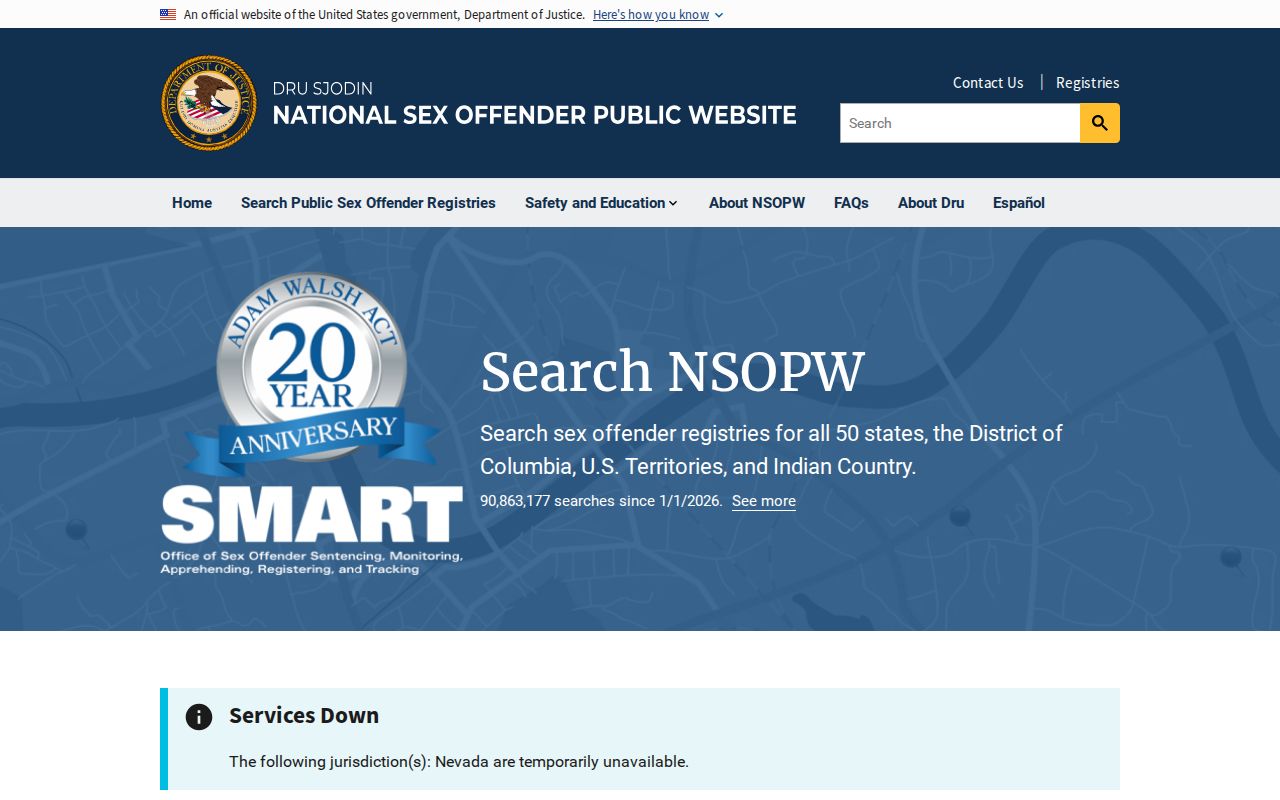
NSOPW is useful when a known person or address may cross state lines, while PSP remains the primary source for Pennsylvania profile details.
The two systems should be compared by purpose, not treated as duplicates. A PSP county search is tailored to Jefferson County geography. NSOPW queries participating jurisdictions through a national gateway. If a result seems absent or stale, check the originating jurisdiction's official registry rather than an unofficial mirror.
For a person known to have lived outside Pennsylvania, use NSOPW first to identify the official jurisdictional source, then open that source for current details. For a location entirely within Jefferson County, PSP supplies the more direct county, municipality, ZIP, and address tools. Neither system is a general criminal-history search. A person may have a criminal court record without any registry duty, and the registry profile does not reproduce the complete police report, docket, sentence file, or current assessment of conduct.
Lawful Use and Community Notification
The registry supports public awareness and informed safety planning. 42 Pa.C.S. §9799.28 governs public Internet dissemination and related use, while §9799.32 addresses PSP registry duties. The official warning directs suspected noncompliance to PSP or the nearest police agency. An emergency belongs with 911. Members of the public should not confront, follow, threaten, or contact a listed person.
Misuse is a crime: Pennsylvania law forbids using registry information to threaten, intimidate, or harass a registrant or household. Report concerns to law enforcement instead.
The Pennsylvania Criminal History Record Information Act provides broader rules for criminal-history information.
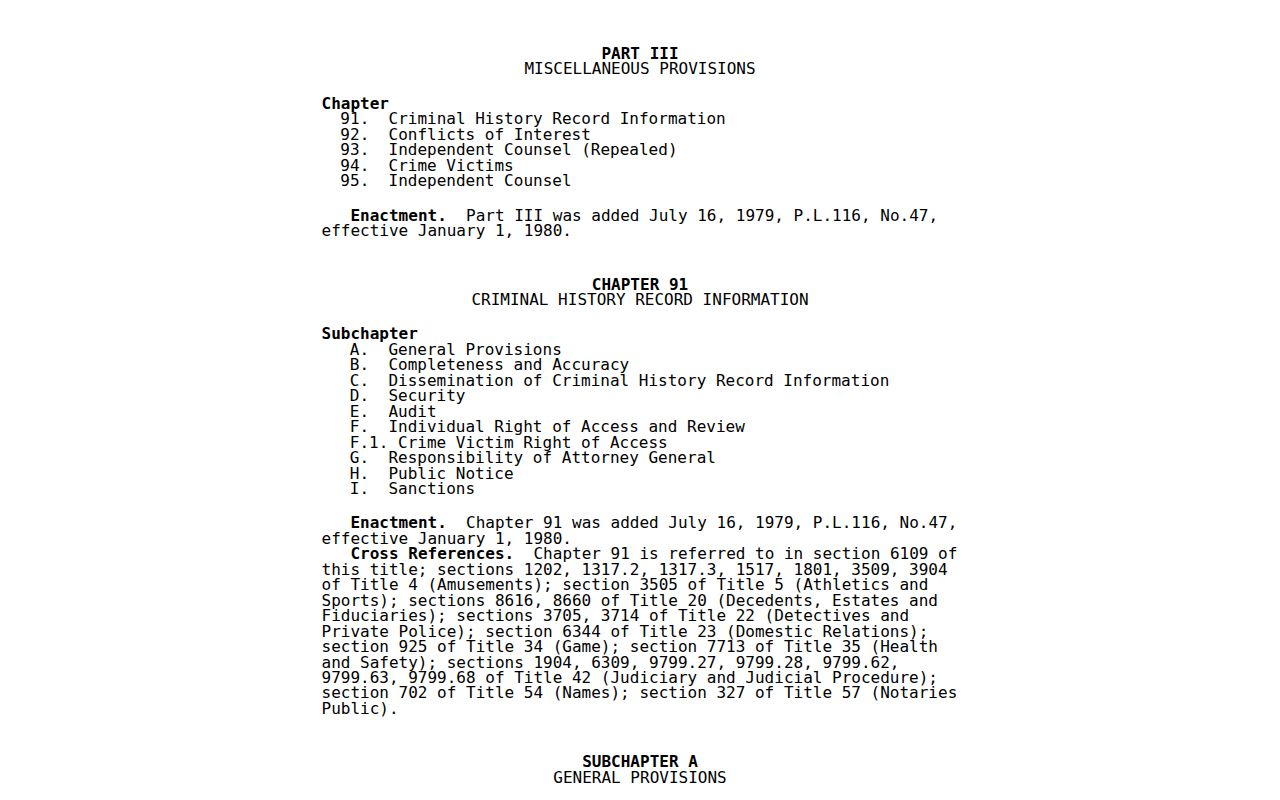
Keeping registry data within its lawful public-notice purpose protects both community safety and the integrity of the official record.
Suspected noncompliance should be described with facts that law enforcement can assess, such as the official profile, observed location, and time. PSP or the nearest police agency can compare that report with information not shown to the public. Do not investigate by following a person, entering private land, or trying to test the listed address. For conduct that presents an immediate threat, use 911. For a profile question that is not urgent, begin with PSP and preserve the page URL or search details that caused concern.